

Using MuVIT Simulations in Training
Enhancing Boating Education with Simulated Radar and Chart Plotter
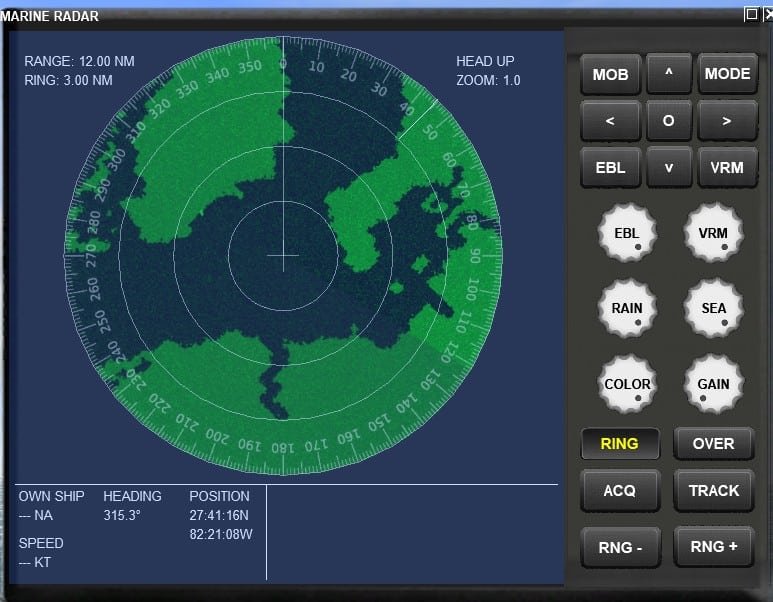
As boating technology continues to evolve, the U.S. Power Squadrons (America’s Boating Club) remains at the forefront of boating education—equipping both members and the public with the knowledge and confidence to operate their vessel safely in all conditions. One powerful teaching aid that supports this mission is the MuVIT virtual trainer which is based on the Virtual Sailor software, a maritime simulation program that realistically replicates vessel operation, navigation instruments, and environmental conditions. The software includes a full function GPS/chart plotter and Radar simulation, which can be used standalone without any additional hardware to teach operation of those devices in either a seminar or classroom environment.

Realistic Simulated Radar for Training
Virtual Sailor’s radar simulation behaves much like the units found aboard many recreational and cruising vessels. Instructors can use it to demonstrate how radar identifies surrounding landmasses, navigation aids, and other vessels—even in reduced visibility such as fog or nighttime conditions.
During a seminar or class, students can learn to:
- Adjust range, gain, tuning, rain and sea clutter controls and learn how they can interact.
- Interpret radar returns, bearings, and relative motion.
- Practice collision avoidance using radar plotting techniques.
- The large variety of vessels available, from small runabouts to large freighters and cruise ships make it possible to practice target identification, a very practical skill in limited visibility situations.
- Understand how radar integrates with other navigation tools for overall situational awareness.
Because the simulation responds dynamically to the boat’s course, speed, and nearby objects, students gain a true sense of how radar behaves on the water—without ever leaving the classroom.
Hands-On Chart Plotter Familiarization
Equally valuable is Virtual Sailor’s integrated chart plotter/GPS, which provides students with a GPS-based electronic chart display. The chart plotter simulation allows participants to:
- Plot waypoints and routes directly on the chart, then run them manually or on autopilot and experience computer assisted grounding.
- Monitor position, heading, and speed in real time. Useful in learning dead reckoning skills.
- See how chart plotter data complements radar and visual navigation for safer decision-making.
This interactive approach reinforces the key concepts taught in courses such as “Boat Handling,” “Marine Navigation,” and “Advanced Marine Navigation.” It helps bridge the gap between classroom instruction and on-the-water experience. Among the charts available is the 1210TR chart, which is referred to as New England in the scenery list.
Bringing Technology to the Seminar Room
For Power Squadron instructors, Virtual Sailor serves as an engaging and cost-effective (~$30) classroom tool. By projecting the simulation onto a screen or sharing it during virtual sessions, instructors can conduct live demonstrations of radar and chart plotter operation. Scenarios can include coastal cruising, harbor approaches, or open-water crossings under a variety of conditions—wind, waves, visibility, and traffic, all adjustable within the software.
This flexibility allows seminar leaders to illustrate real-world navigation challenges and proper instrument use in a controlled, repeatable setting. Members can safely explore “what-if” situations, such as identifying contacts in limited visibility or adjusting a course to avoid a collision.
Advancing America’s Boating Education Mission
By incorporating Virtual Sailor into classroom presentations and seminars, U.S. Power Squadrons instructors can provide students with a hands-on, visual understanding of how radar and chart plotter systems function and interact. The result is a more engaging and effective learning experience that enhances members’ confidence before they put their skills into practice on the water.
As boating continues to rely on advanced electronics, simulation-based instruction ensures that America’s Boating Club members remain proficient, safety-minded, and ready for the challenges of modern navigation.

