

Alternatives to the Logitech Wingman Wheel
One of our ongoing goals with MuVIT is to keep the platform flexible and consistent regardless of what hardware someone happens to have on hand. The wheel we’ve relied on for years, the Logitech Wingman wheel, is a great piece of gear, but it’s also a genuinely old product; it first hit the market back in 2000. It still works well as a helm wheel today, but we know not everyone has one sitting in a closet, and some builders may already own newer Logitech wheels from old sim-racing rigs or upgrade programs. So we set out to answer a simple question: if you don’t have a Wingman, what else can you use?
We rounded up a few of the more common Logitech wheel variations that have shown up in racing setups over the years and put them through their paces with MuVIT to see how they’d hold up as a helm replacement.
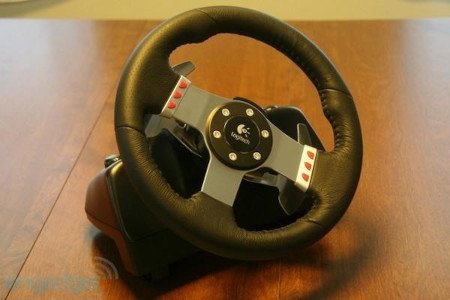
Logitech G27 Wheel
The Logitech G27
The G27 was released back in 2009, and even though it’s no longer a current product, it’s still easy to find and remains a genuinely solid option. It’s a powered wheel, which means it meets all the requirements MuVIT needs to operate correctly, and unlike some alternatives, it’s self-calibrating. That’s a nice convenience; you don’t have to manually center the wheel before every session.
In our testing, the G27 turned out to be a true plug-and-play replacement for the Wingman wheel. No extra configuration, no workarounds, no headaches. The one thing worth knowing ahead of time: when you power the system on, the G27 runs through a calibration cycle where it spins back and forth on its own before it’s ready to use. If it isn’t securely mounted when that happens, you’re going to have a bad time. Trust us on this one; we found out the hard way and have the bruises to show for it, and we’d rather you not repeat the experiment.
If you happen to already have an old BSVT wheel lying around, it’s worth using rather than buying something new. No sense spending money you don’t have to.
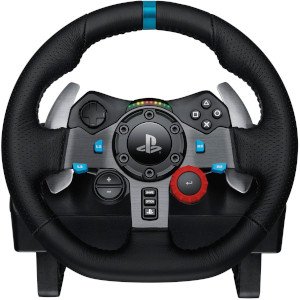
Logitech G29 Wheel
The Logitech G29
Released in 2015, the G29 is essentially a G27 with updated internals; it swaps the older optical sensor for a hall effect sensor. Functionally, our assessment lines up closely with what we found on the G27; it does the job.
Where it falls short, in our opinion, is ergonomics. The G29 comes with a lot of extra hardware bolted onto the wheel itself paddles, switches, and assorted “stuff” — that makes it feel cluttered and less intuitive to use for something as simple as steering a boat. None of that extra complexity is needed for MuVIT, and it just gets in the way. If we’re choosing between the two, we’d take the cleaner, simpler G27 every time.
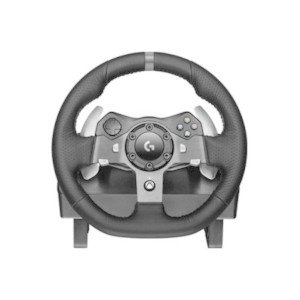
Logitech G920 Wheel
The Logitech G920
The G920 is a newer entry in the lineup. We haven’t gotten our hands on one to test directly, but based on its specs, we’d expect it to work just fine with MuVIT it uses the same Hall effect sensor technology as the G29.
Like the G29, though, it comes loaded with buttons scattered around the wheel in some fairly unusual spots. Between the added complexity and the fact that it’s not something we’ve personally verified on the bench, our recommendation stands: stick with the G27 if you can. Its uncluttered design and optical encoder make it the simplest and most predictable choice of the bunch.
The Logitech Wingman Wheel – Do You Need to Switch?
If you already have a Logitech Wingman wheel running in your existing MuVIT system, the short answer is: don’t touch a thing. The current software works perfectly well with it, and there’s no reason to fix something that isn’t broken. This roundup is really aimed at new users who are still shopping for hardware and want to know what their options look like before they buy.
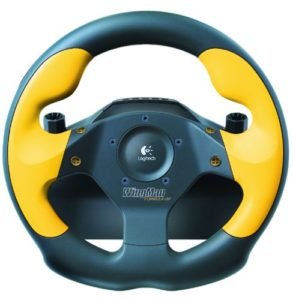
Looking ahead, there’s a good chance we’ll bring the Wingmanongpn wheel back into the MuVIT store in the near future, and for two main reasons. First, cost: these Wingman wheels show up on the used market at very attractive prices, which meaningfully lowers the total cost of building a system. Second, simplicity: the Wingman’s uncluttered design is honestly all you need. Rear paddles to pan your view left and right, a horn button, and a zoom button for the binoculars effect. That’s the complete feature set, and it’s enough. When it comes to helm hardware, keeping things simple and unconfusing wins out over a wheel covered in buttons you’ll never use.
Note: We recommend the Wingman Wheel Formula Force GP wheel, as the original non-GP version used internal bungee cords, which tended to stretch, and pretty soon you had a wheel that wasn’t aligned properly.


