Teaching the Rules of the Road with Virtual Sailor: Using Waypoints and Autopilot to Build Real Navigation Skills
This is part 2 of a 2 part series. Part 1 is here
Every mariner eventually has to learn the Rules of the Road, the International Regulations for Preventing Collisions at Sea (COLREGs) that govern who gives way, who stands on, and how vessels are supposed to behave around each other. Those rules are easy to recite and hard to internalize because the tricky part isn’t memorizing them; it’s recognizing a developing situation in time to act on it. That’s precisely the kind of judgment that’s difficult to teach from a textbook and expensive and risky to teach on the water with a boat full of students. Virtual Sailor’s waypoint and autopilot system turns out to be a surprisingly good bridge between the two.
Why Scripted Traffic Is a Teaching Tool
The instinct might be to have students navigate against each other live, but for teaching purposes, there’s a lot of value in the instructor controlling the other traffic instead. By laying waypoints for a set of vessels and putting each one on its own autopilot route, an instructor can build a scene where every other ship’s behavior is known, repeatable, and deliberately designed around a specific lesson. The student vessel is the only one being actively conned. That predictability is what makes it a teaching tool rather than just a busy harbor: the instructor knows exactly what’s going to happen, and can walk the class through why.
Because each vessel keeps its own independent waypoint route and autopilot state, the same encounter can be run over and over, exactly the same way, for as many students as need to see it. Something you can’t do with live traffic on the water and can’t do safely at all with real vessels.
Rules of the Road Scenarios You Can Build
The waypoint system makes it straightforward to construct the classic rule of the road situations on purpose, rather than waiting to stumble into one:
Crossing situations (Rule 15). Route a second vessel on waypoints that intersect the student’s course at an angle. With the give-way and stand-on roles clearly defined by the geometry, students have to identify which vessel they are and what ”keep out of the way” actually looks like in practice. Course change, speed change, or both, and how early is early enough.
Head-on encounters (Rule 14). Set a scripted vessel’s waypoints to bring it straight down the reciprocal of the student’s course. This is a useful one precisely because the correct action is that both vessels alter to starboard; it is simple to state and easy to get wrong in the moment when a ship is growing larger dead ahead.
Overtaking (Rule 13). Put a slower scripted vessel on a route ahead of the student’s boat, and let the student close from astern. It’s a good contrast case: overtaking is governed differently from crossing, and running the scenario lets students feel the difference between the two rather than just reading it.
Restricted visibility and narrow channels. Combine scripted traffic with the sim’s adjustable weather and sea conditions to run the same encounters in fog or heavy weather. Or route vessels through a charted channel to practice the added rules around staying to the starboard side and not impeding vessels that can only navigate within the channel.
Multi-vessel scenes. Once students are comfortable with one-on-one encounters, an instructor can populate a harbor or channel with several independently routed vessels at once, a ferry on a fixed schedule, a slower fishing boat, and a ship transiting through. Students have to sort out priority among multiple contacts simultaneously. This is a much better rehearsal for real traffic than any single-ship drill.
Beyond the Rules of the Road
The same waypoint-and-autopilot workflow supports broader navigation instruction:
- Route planning. Have students lay their own waypoints for a passage around a headland, through a channel, into a harbor, and then critique the route for hazards, traffic separation, and safe margins before they ever get underway.
- Cross-track error and course-keeping. Watching how a vessel on autopilot converges back onto a plotted line after a disturbance is a concrete, visual way to teach the concept of cross-track error, rather than leaving it as an abstract term in a chart plotter manual.
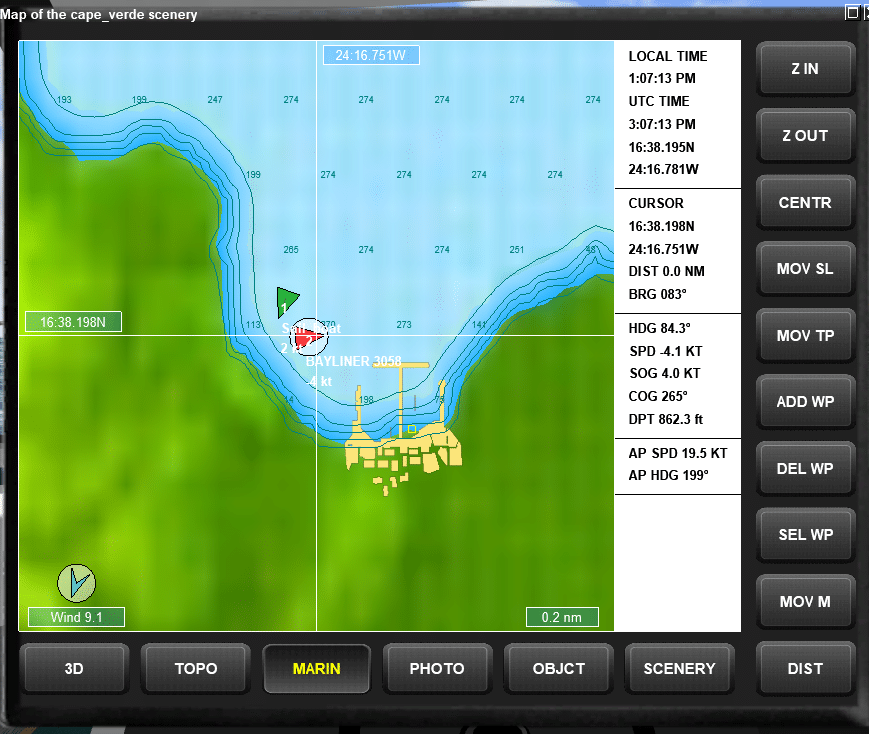
- Passage debriefs. Because each vessel’s route persists and can be replayed, an instructor can walk back through a scenario after the fact and point to the exact moment a give-way action should have started. This is done using the plotted routes as a shared reference rather than relying on memory of what happened.
Setting It Up for a Class
A few practical habits make this work well as a teaching exercise rather than just a demo:
- Build scenarios in advance by routing each non-student vessel and saving the routes so class time goes to the encounter itself rather than to setup.
- Stagger vessel departures deliberately. Since a loaded vessel’s engine and autopilot start in an off state until you set them, an instructor can time exactly when a scripted ship gets underway. This is what lets a crossing or head-on situation develop at a predictable point in the lesson instead of by chance.
- Isolate one rule at a time before combining them. Show waypoints only for the vessel involved in the current lesson rather than the whole traffic picture so students aren’t trying to parse an encounter and a cluttered chart at the same time.
- Escalate complexity across a course. Start with single, clean encounters, then move to multi-vessel scenes and degraded visibility as students build confidence; the same tools scale from a first lesson on crossing situations to a capstone exercise in a busy, foggy channel.
The Payoff
None of this requires anything beyond the sim’s existing waypoint and autopilot system; the same tools used to build believable traffic can just as easily be aimed at teaching the rules of the road. What changes is the intent behind the setup: instead of routing vessels to make a harbor feel populated, an instructor routes them to put a student in a specific, well-understood situation. Run it as many times as needed, and debrief it afterward with the routes still on the chart to point to. It’s a low-stakes, repeatable way to build the kind of pattern recognition that, on the water, usually only comes from years of experience or a close call.